For PSP Operations / Patient Support Teams
From Enrolment to Verified Follow-Through. One Connected PSP Operation.
Enrol and assess patients, prioritise follow-up, coordinate nurses, and verify what happened next, within one connected support operation.
- 01Which patient needs attention?
- 02Who owns the follow-up?
- 03What happened next?

Identify persistence risk early
Detect delayed, missed or extended treatment patterns before patients disengage.
Focus on the right patients
Prioritise high-risk, ageing and unresolved cases based on urgency and programme context.
Manage cases efficiently
Maintain clear ownership, next actions, case status and workload visibility.
Verify intervention and outcomes
Track what was done, whether the barrier was resolved and what happened next.
Demonstrate PSP value
Provide de-identified operational evidence to pharma without relying on manual justification decks.
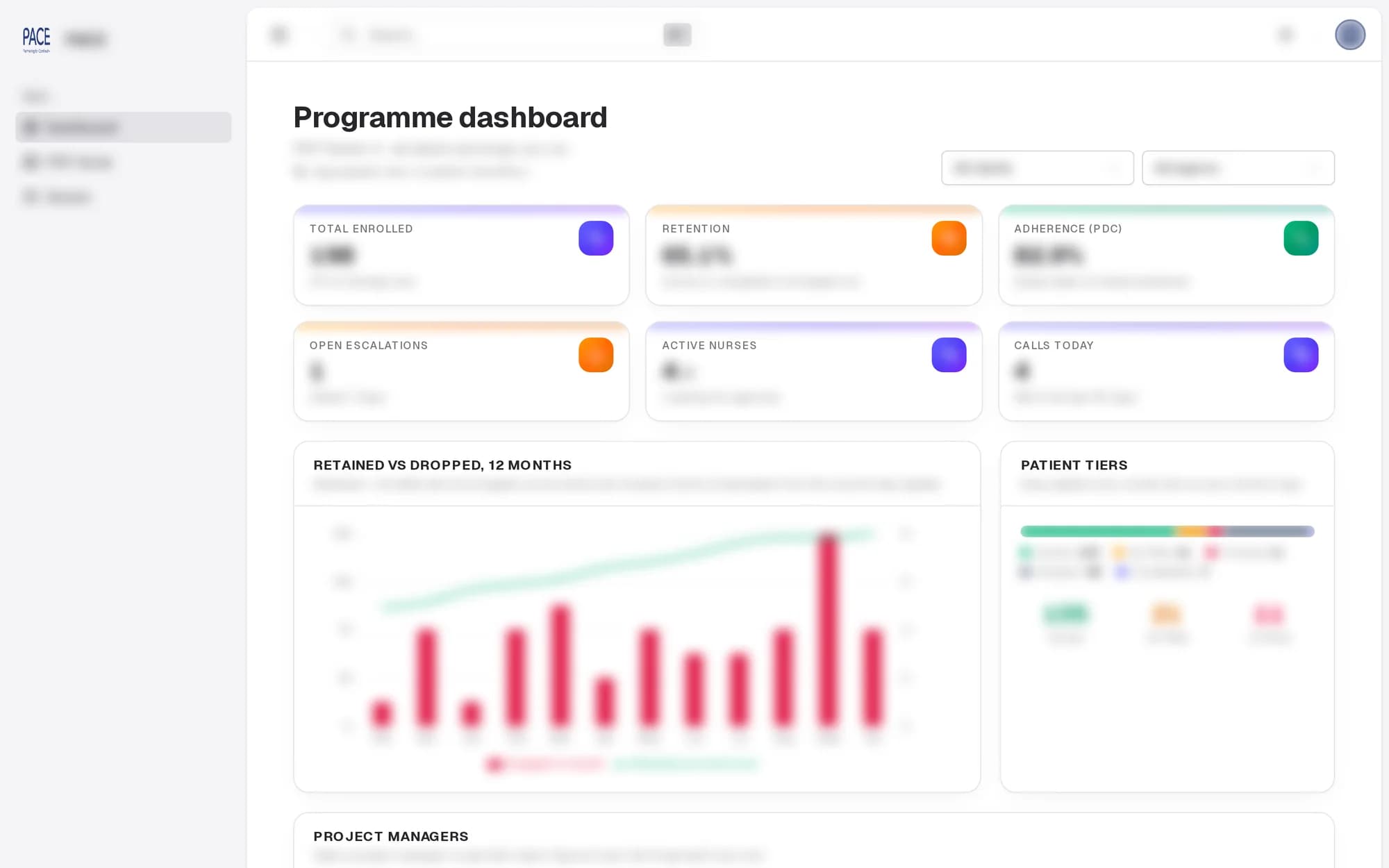
PSP operations view
Illustrative dashboard126
Open cases
14
Ageing cases
82%
Documented resolution
4.5
Median days to resolution
Priority queue
| Case | Pathway | Risk reason | Urgency | Days open | Owner | Next action |
|---|---|---|---|---|---|---|
| Case 0418 | Fixed SC | Extended interval | High risk | 6 | Coordinator A | Confirm next dose |
| Case 0391 | IV-to-SC | Barrier unresolved | Emerging risk | 9 | Nurse B | Escalate barrier |
| Case 0377 | Phased SC | Missed dose reported | Emerging risk | 3 | Coordinator C | Follow-up call |
| Case 0352 | Fixed SC | Delayed dose | Monitor | 2 | Nurse D | Reminder check |
Persistence-risk mix
- On rhythm68%
- Monitor18%
- Emerging risk10%
- High risk4%
Open cases by age
- 0 to 7 days84
- 8 to 14 days28
- 15 to 30 days10
- 30+ days4
Team workload vs capacity
- Team North38 / 40
- Team Central41 / 45
- Team West27 / 40
- Team East20 / 35
Interactive multi-role experience
One patient journey. The right view for every role.
Patient experience
Support before the next treatment event.
Personalised engagement, treatment reminders, multilingual check-ins and a clear route to support, after appropriate programme enrolment and consent.
- Digital companion & reminders
- Support requests & check-ins
- Consent-aware engagement
Access: the patient’s own programme-facing information.
PSP nurse / educator
Know who needs follow-up, and why.
Review prioritised patients, complete rapid post-consent assessments, capture safety/PV concerns, document actions and transfer cases safely during leave coverage.
- Post-consent rapid assessments
- Risk, interventions & PV handoffs
- Leave coverage acceptance
Access: assigned authorised patient cases only.
PSP programme manager
Coordinate cases, workload and execution.
Manage enrolment, consent-linked assessments, follow-ups, safety/PV report handoffs, HCP report schedules, nurse assignments and documented resolution in one programme view.
- Enrolment, consent & assessment queue
- Safety/PV ownership & HCP cycles
- Educator SLA and nurse coverage controls
Access: programme-scoped operations, according to assigned permissions.
PSP director / operations lead
Lead programmes with evidence, not fragments.
See cross-team performance, assessment completion, PV handoff acknowledgement, HCP report delivery, nurse SLA, intervention throughput and accountability. Identify programmes that need staffing or workflow support.
- Programme and workforce KPIs
- Multi-brand operational visibility
- SLA, capacity & governance trends
Access: authorised management metrics and programme-level operational summaries.
Monthly treating-HCP report, recipient preview
A clear monthly summary of the patients you treat.
PACE automatically prepares monthly patient-specific PSP progress reports for each authorised treating HCP. This demonstrates an approved secure report, not a separate HCP login portal.
- Assigned patient list only
- Treatment-continuity review flags
- Follow-up and report-cycle traceability
Access: verified treating HCP recipient; programme-approved patient-level report only. Pharma commercial access remains aggregate.
Pharma / PAM governance
See programme outcomes without exposing care records.
Monitor consistent aggregate indicators, patient-support delivery, treatment-continuity trends and authorised PSP transition performance independently of any one provider.
- Aggregate programme scorecards
- Intervention-to-outcome trends
- Vendor-neutral continuity oversight
Access: aggregate/de-identified sponsor reporting; no patient-level nurse notes or identifiable care data.
Role-based access: Patient-level care and case information is restricted to authorised PSP/care roles. Pharmaceutical views are aggregate/de-identified and governed by approved data arrangements.
Full patient support journey
From enrolment and consent to accountable continuity.
Stage 01 / Enrolment
A clean starting point for every programme.
Register an eligible programme participant using authorised fields, capture programme status and preserve the source reference for later reconciliation.
Accountability record
Enrolment record created
Owner: PSP onboarding team
Stage 02 / Digital consent
A documented permission before engagement.
Capture consent version, date, channel, status, and withdrawal/STOP events under approved programme requirements.
Accountability record
Consent state validated
Owner: PSP onboarding / authorised team
Stage 03 / Nurse assessment
Capture the nurse assessment faster after consent.
Use an approved, structured PSP assessment form, prefilled with permissible enrolment fields. Nurse records patient-reported barriers, review needs and assessment completion.
Accountability record
Nurse assessment saved or kept as a draft
Owner: Authorised PSP nurse
Stage 04 / Patient engagement
Support around real treatment schedules.
Deliver personal reminders, Arabic/English engagement and support check-ins within the approved specialty-treatment journey.
Accountability record
Check-in or support request recorded
Owner: Patient / PSP digital programme
Stage 05 / Risk intelligence
Detect emerging treatment-continuity risk.
Convert configured engagement and treatment signals into prioritised review flags; do not interpret every missing confirmation as a missed dose.
Accountability record
Potential risk event identified
Owner: PACE monitoring rules
Stage 06 / Nurse ownership
Put actionable work in the right queue.
Escalate relevant cases to an authorised PSP nurse with a due time, current ownership and escalation history.
Accountability record
Case assigned and acknowledged
Owner: PSP nurse / programme manager
Stage 07 / Intervention
Document human-led support and barriers.
The nurse assesses the situation, selects the appropriate approved response and records the contact, barrier and follow-up status.
Accountability record
Intervention logged
Owner: Assigned PSP nurse
Stage 08 / Verification
Keep resolution separate from activity.
Capture resolved, unresolved or unknown barrier states and monitor the next documented treatment event where data are available.
Accountability record
Resolution / continuity state updated
Owner: PSP team / authorised data flow
Stage 09 / Accountability
Measure operations and continuity responsibly.
Provide PSP leaders with operational metrics, authorised treating HCPs with scheduled monthly patient reports, and pharma with aggregate/de-identified programme intelligence.
Accountability record
Aggregate programme view refreshed
Owner: PSP leadership / authorised sponsor view
Current challenge
Risk becomes visible too late
Patients may drift before reporting a barrier.
High and unbalanced workload
Teams need to know which patients need attention first and who has capacity.
Unclear case ownership
Actions, next steps and outcomes may not be consistently tracked.
Multiple data sources
Patient information can be spread across tools, increasing coordination effort.
Vendor/team changes and handovers
Continuity can be lost when staff are unavailable or cases transfer.
Limited intervention-to-outcome visibility
Activity reporting does not always show whether support resolved the barrier and improved continuity.
Time-consuming pharma reporting
Manual consolidation reduces time available for patient support.
Operational modules
Streamlined enrolment & consent
Digitise programme enrolment and consent where implemented.
Persistence-risk early warning
On rhythm, monitor, emerging risk and high risk, based on documented treatment-rhythm signals and programme rules/model.
Priority queue
Patient/case ID, therapy, last relevant treatment signal, risk reason, urgency, days open/overdue, owner, next action and status.
Case ageing & resolution
Track ageing buckets, unresolved barriers, response time, resolution status and time to resolution.
Dynamic case reassignment
Maintain support continuity when a nurse/coordinator is unavailable, overloaded or reassigned. Preserve context and next action.
Field team capacity & effectiveness
View workload, coverage, ageing cases, response time, documented resolution and team-level outcomes for resource optimisation.
Pharma-ready performance evidence
Show who needed support, what was done, response progress, resolution and programme-level continuity outcomes in de-identified sponsor reports.
Independence does not mean replacement or adversarial auditing.
PSP teams continue to execute care; PACE helps them prioritise work, preserve handover context and demonstrate documented delivery more clearly to pharma.
PSP Operations workflow
- 1Enrol
- 2Identify persistence risk
- 3Prioritise
- 4Assign owner
- 5Intervene
- 6Verify resolution
- 7Monitor continuity
- 8Report impact
PSP outcomes
- Earlier persistence-risk identification
- Smarter patient prioritisation
- Clearer case ownership
- Faster resolution of ageing/unresolved cases
- More balanced workload
- Stronger adherence/persistence support
- Measurable intervention effectiveness
- Stronger evidence of PSP value to pharma
Safety governance and treating-HCP communication
Safety signals are traceable. Treating HCPs stay informed.
Post-enrolment nurse assessment
Enrol. Obtain consent. Complete the assessment, without duplicate entry.
PACE gives PSP nurses structured, programme-configurable assessment forms after authorised enrolment and valid digital consent. Reuse approved enrolment details, capture outstanding fields and preserve a timestamped assessment record.
PACE does not automate the nurse's clinical judgement.
Monthly automated HCP reports
The treating HCP sees their patients' follow-through.
PACE generates scheduled monthly, HCP-scoped patient summaries that support continuity review. Each authorised treating HCP receives only the patients assigned to them through an approved secure delivery channel.
Scoped to the authenticated treating HCP's authorised patients.
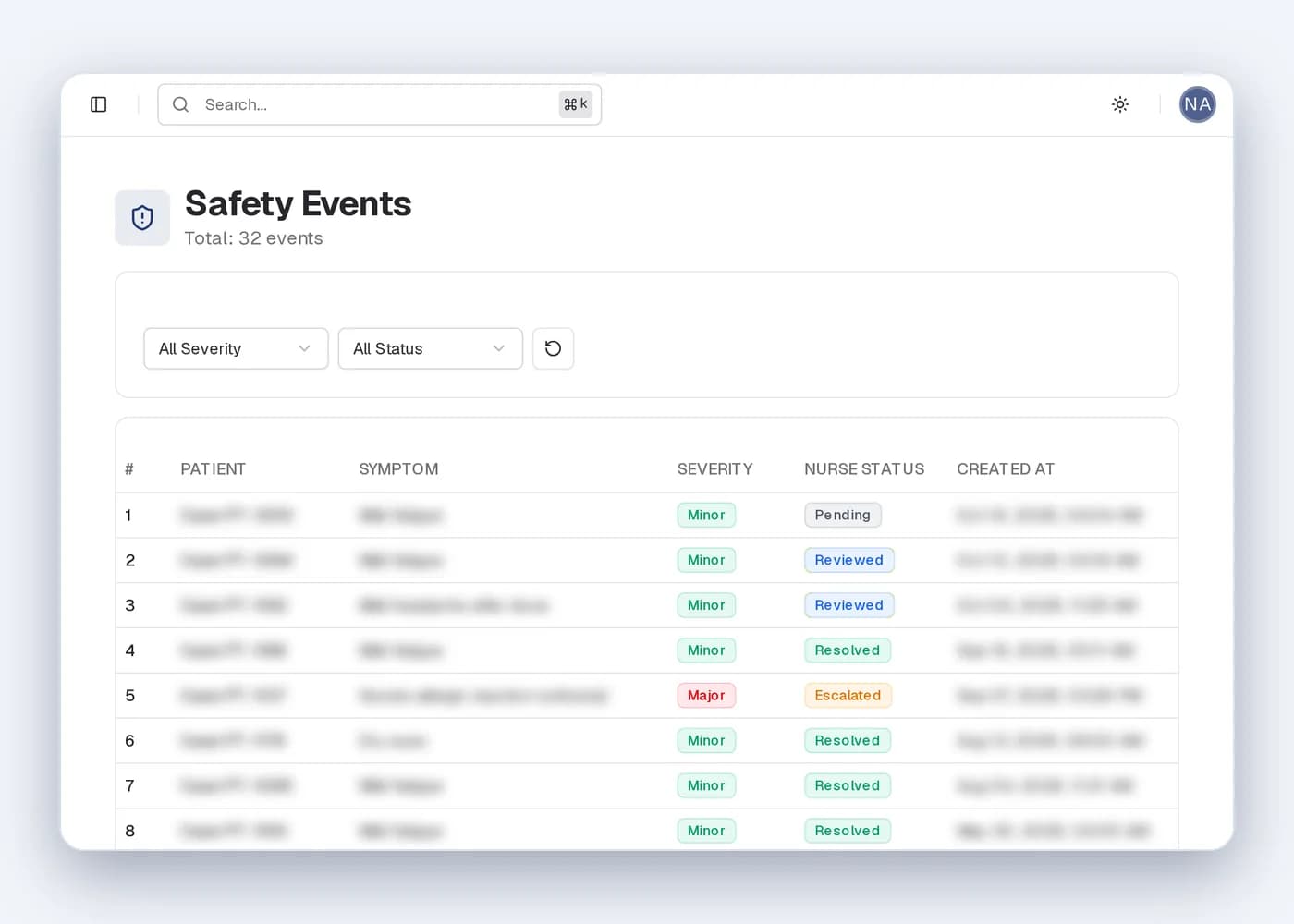 Illustrative dashboard
Safety / pharmacovigilance
Capture. Route. Acknowledge. Track.
Nurses record a reported safety event using a structured PV form. PACE tracks routing to the authorised safety/PV recipient, acknowledgement, due times and required follow-up under the partner's SOP.
Does not submit regulatory reports, assess causality, make clinical decisions, or substitute for required PV personnel and reporting obligations.
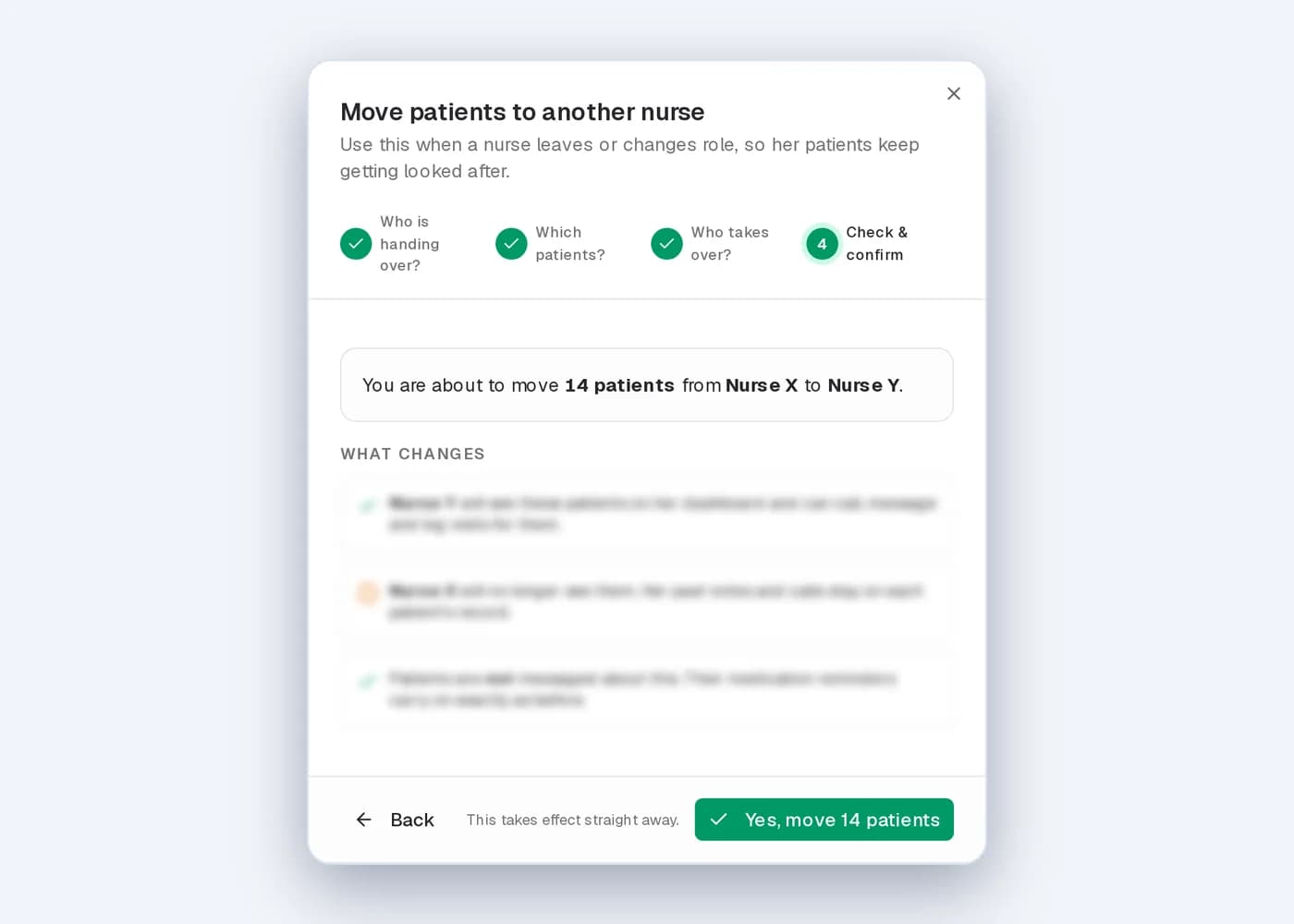 Illustrative dashboard
Nurse-to-nurse continuity
A nurse takes leave. Patient follow-ups don't disappear.
PACE makes temporary case coverage visible to managers and receiving nurses, preserving the task history, urgency and accountability of every approved handover.
The SLA does not reset when ownership changes.
Clear access boundary: PSP nurses and authorised healthcare recipients may access relevant patient-level reports on a verified need-to-know basis. PSP directors/managers see only their approved operational scope. Pharmaceutical commercial users receive role-appropriate, aggregated/de-identified programme metrics, not these HCP-specific patient reports or PV narratives.
For PSP directors and operations
Make PSP operational capacity visible, actionable and measurable.
- No patient-identifiable inputs
- Assumption-based scenarios
- Operational capacity is not cash savings
Your operating baseline
Enter programme data
Reporting workload should not duplicate follow-up administration time.
The percentages are illustrative planning assumptions, not published PACE performance results or industry benchmarks.
Illustrative annual opportunity
Illustrative planning scenarioYour operational capacity scenario
- Potential hours released
- 477 hours
- Admin + reporting capacity
- Equivalent working days
- 60 days
- At 8 hours per day
- Possible support interactions
- 954
- If capacity is reassigned
- Capacity-value equivalent
- SAR 42,912
- Not realised cost savings
Modelled manual workload: 3,717 hours/year
12.8% of baseline workload potentially released
This tool does not calculate financial ROI, retention improvement, actual cost reduction, or the causal impact of PACE. Real outcomes require a defined baseline and a measured implementation.
Transparent calculation methodology
- Annual follow-up admin hours = patients × follow-ups × admin minutes ÷ 60.
- Annual reporting hours = reporting hours per month × 12.
- Potential hours released = follow-up admin hours × assumed admin reduction + reporting hours × assumed reporting reduction.
- Working days = released hours ÷ 8.
- Capacity-value equivalent = released hours × assumed staff hourly cost.
- Possible interactions = released hours × redeployable share × 60 ÷ time per interaction.
Measure incremental realised benefit against all incremental costs, including implementation, integration, training, licensing and operations. Avoid equating capacity release with cash savings; outcomes and attribution require evidence.
Risk-to-action time, administrative minutes per contact, monthly reporting time, overdue cases, resolution documentation, nurse handover completion and treatment continuity outcomes where appropriate.
Integration or white-label
Fit the PSP ecosystem. Close the intervention loop. Preserve continuity.
Connect
PSP-agnostic data integration
Connect authorised PSP workflows through APIs, existing CRM and EHR interfaces, FHIR-aligned interoperability where supported, or structured CSV imports.
Integration approach scoped to each partner
Enable
White-label PSP deployment
Enable a PSP-branded experience for eligible programmes while retaining PACE's underlying continuity and operational intelligence layer.
Branding and configuration vary by agreement
Bring one programme challenge. See how PACE addresses it.
Walk through prioritisation, case ownership, resolution and de-identified performance evidence for one programme.
Pilot proof-of-value measures
- Time from risk signal to action
- Overdue follow-ups
- Ageing unresolved cases
- Documented resolution
- Persistence / discontinuation
- Handover completeness